DruGS Program Lead Dr Adrian Farrugia has recently completed ARC DECRA-funded research examining the ways gender and sexuality are addressed in drug education, articulated by drug education professionals and understood by young people. The research findings have been published in a new report entitled Addressing gender and sexuality in drug education.
The report is available online.
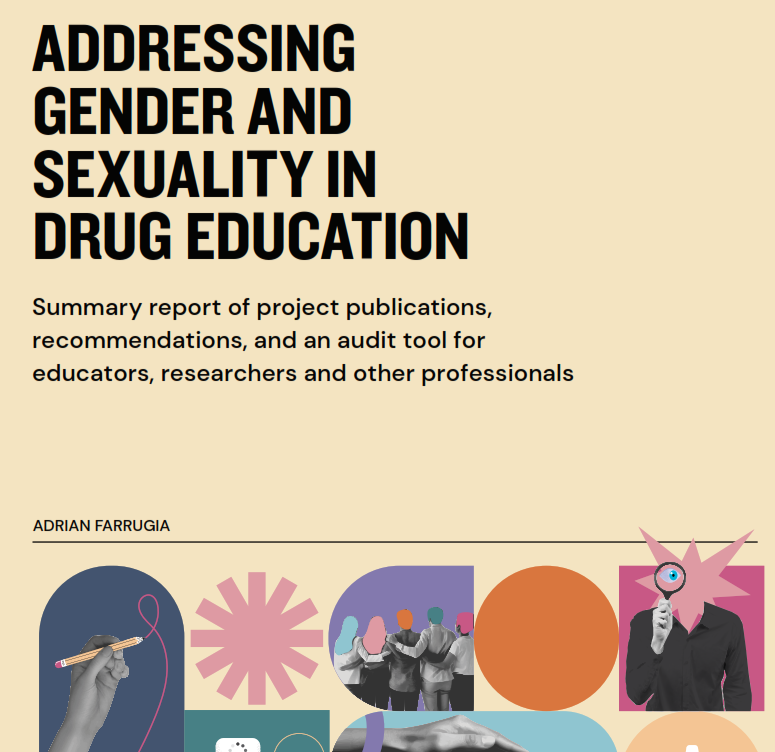
The new report summarises the publications produced by the research, presents 10 recommendations for drug education curriculum and research, and is accompanied by a tool designed to assist drug education professionals in integrating these findings into their practice. These findings and drug education tool are based on an analysis of three datasets:
- a corpus of Australian drug education materials designed for use in secondary schools
- interviews with 40 young people experienced with alcohol and other drug consumption and/or school-based drug education
- interviews with 20 drug education professionals responsible for the design and delivery of drug education initiatives
Overall, the findings suggest that while gender and sexuality play an important role in shaping young people’s understandings and experiences of alcohol and other drugs, drug education responses often struggle to adequately address this relationship. Responding to this, the report includes a tool that provides practical strategies for ensuring drug education curriculum resources address several key issues in an effective and, importantly, ethical manner. Drawn from the research informing the tool, these key issues include:
- addressing the relationship between alcohol and other drugs and stigma
- making decisions about alcohol and other drugs
- understanding the role of alcohol and other drug consumption in social life
- examining how issues related to gender and sexuality are addressed
As project lead Dr Adrian Farrugia explains,
Drug education and prevention are rarely subjected to the kinds of critical scrutiny that have become routine in other complex areas of education such as that on relationships, sex and sexuality. While gender and sexuality are known to shape young people’s drug experiences, including associated harms, there has been limited attention to how these issues are addressed within drug education. This research responds to this and, I hope, offers productive new directions for understanding young people’s drug consumption and efforts to reduce harm.
Project publications
Farrugia, A., Ekendahl, M., Keane, H. & Rasmussen, M. L. (2026). Everyday intoxications: A qualitative analysis of young people’s alcohol and other drug consumption. Contemporary Drug Problems, Online First.
Farrugia, A., Pienaar, K. & Dennis, F. (2025). Narcofeminist affects: Gender, harm and fun in young women and gender diverse people’s experiences of alcohol and other drug consumption. The Sociological Review, Online First.
Farrugia, A. (2025). Agency, sex and drug education: Examining the response-ability of education responses to consumption, sex and harm. Health: An Interdisciplinary Journal for the Social Study of Health, Illness and Medicine, 29 (6), 821 – 837.
Farrugia, A. (2025). ‘Something serious’: Biopedagogies of young people, sex and drugs in Australian drug education. Pedagogy, Culture and Society, 33 (3), 905 – 201.
Farrugia, A. (2024). ‘Drug education as a site of sexuality education’ in L. Allen and M. L. Rasmussen (Eds.), The Palgrave encyclopedia of sexuality education (pp. 1 – 9). Palgrave MacMillan, Cham.
Farrugia, A. (2023). Under pressure: The paradox of autonomy and social norms in drug education. International Journal of Drug Policy, 122, 104194.


 DruGS
DruGS 
You must be logged in to post a comment.